Practical guides
How High Should You Hang an Art Print Above a Sofa?
Practical guide to hanging premium art prints above a sofa: height, width, framed vs unframed. Studio Vallor tips.
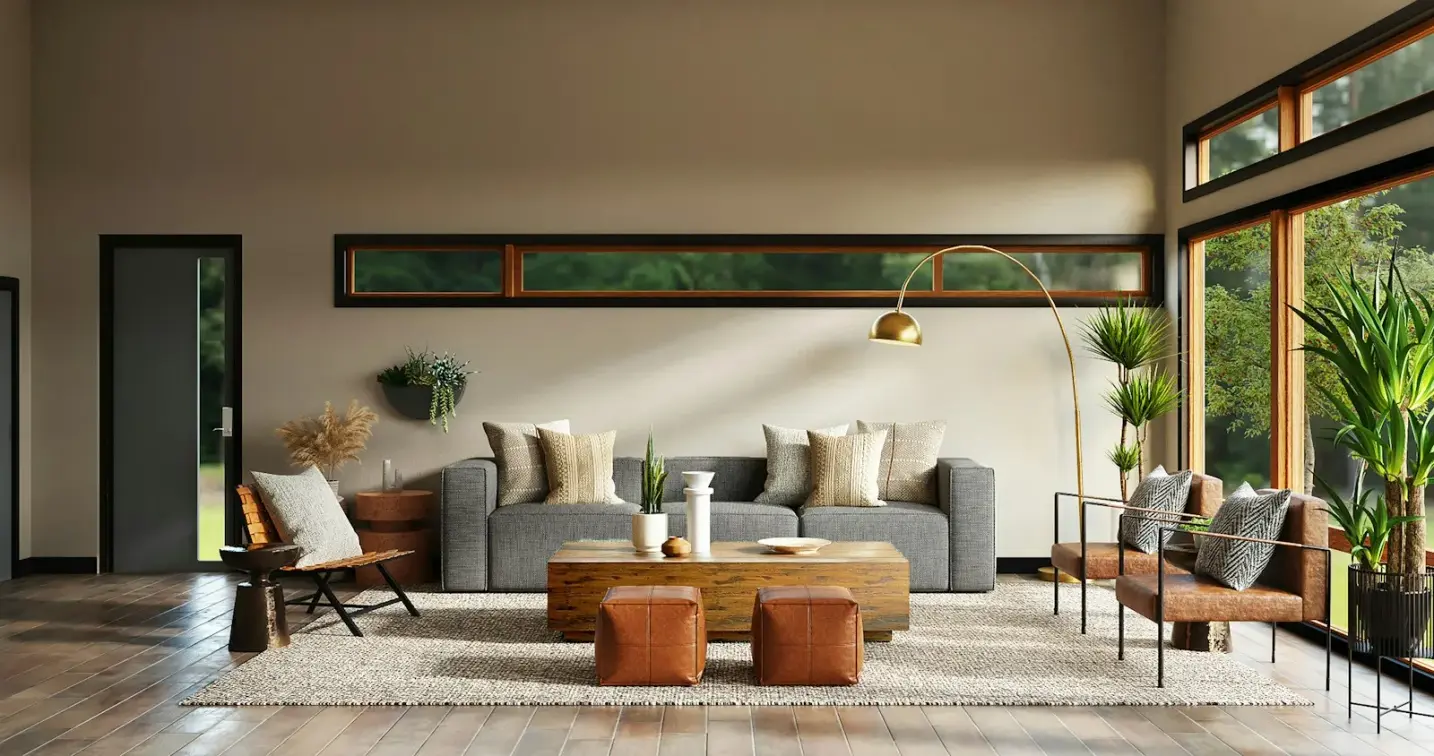
A sofa is a long, low mass. The print above it either joins that line or drifts off toward the ceiling. Most living rooms fail the second way. Someone hangs the picture at a comfortable standing height, leaves a polite gap, and ends up with a blank band that makes the wall look unfinished.
This is a placement note for a premium art print, the kind printed on 250 g/m² paper and meant to stay. It is not a gallery-wall recipe. If you are grouping several frames, treat the group as one object and read Creating a gallery wall for the rhythm between them.
Why sofa and print form one visual unit
The sofa already occupies the lower half of the view. A print that ignores it looks borrowed from another room. A print that sits just above the backrest reads as part of the same piece of furniture, the way a lamp belongs to a side table.
That is why the useful measure is the gap, not a nail height copied from a museum. Galleries hang so the centre of a work meets a standing eye, often somewhere around 145 to 155 cm from the floor. Atelier Lumin uses that range, then immediately qualifies it: once art sits over furniture, the relationship between the two matters more than the open-wall habit. Above a sofa, the backrest wins.
Sit down before you mark anything. If the print disappears behind the cushions when you are actually in the seat, it is too low. If you mostly see wall, it is too high. The standing check comes second.
Height rules that actually look intentional
Leave about 15 to 25 cm between the top of the sofa back and the bottom of the frame (or the bottom edge of an unframed sheet). Closer than that, the print crowds the cushions. Much more, and it floats.
Atelier Lumin sits toward the tighter end of that band, roughly 15 to 20 cm, so the artwork stays tied to the seating. Fifteen centimetres suits a standard ceiling and a tall back. Toward 25 cm, a low modern sofa has room to breathe without the picture climbing the wall. High ceilings are not an invitation to chase the cornice. If the wall feels empty above the print, the answer is a taller format, or a second piece, not a bigger gap.
Measure to the outer edge. A moulding adds height that the image itself does not have. Mark the bottom line with tape, live with it for an evening, and only then make a hole. Centre the print on the sofa, including the arms, even when the sofa is not centred on the wall. The wall can be wider. The composition is the sofa.
Width: matching print to sofa
For a single statement print, aim for roughly 60 to 75 percent of the sofa’s width. Atelier Lumin uses the same proportion for art above furniture. A print as wide as the sofa, edge to edge, feels jammed. A small sheet over a three-seater looks accidental.
Studio Vallor prints in 30 × 40, 50 × 70 and 70 × 100 cm. A lone 30 × 40 cm above a wide sofa rarely carries the wall. A 50 × 70 or a 70 × 100 in landscape orientation often will, depending on the sofa you actually own. Measure, then choose. If one sheet cannot reach the width, two or three aligned prints can, provided they share a frame and a mood. That is a small row, not a scattered gallery.
Keep a margin of wall beyond the arms. The print should sit inside the sofa, not compete with it.
Framed vs unframed premium posters
The house paper is 250 g/m². It has body. Hung bare, it still weighs less to the eye than the same image in a frame, because a moulding draws a dark or wooden border that the sheet does not have.
You can order each poster unframed, or in a ready-to-hang frame: natural oak, dark oak, matte black or matte white. Measure the framed piece to the outside of that moulding. For an unframed sheet, the bottom edge is the paper. Use the same 15 to 25 cm gap. If the bare sheet still looks as if it is hovering, drop it a centimetre or two, staying inside the band. Do not “correct” a light sheet by hanging it higher. That is the mistake the gap rule exists to stop.
A frame also changes the fixing. A 250 g/m² sheet is a light object. Glass and wood are not. Match the hook to the finished weight, and keep adhesive off the printed face. The paper does not forgive a strip pulled off the image.
Common mistakes
Hanging for the person standing in the doorway, then never sitting down. The sofa is where the picture is seen.
Centring on the wall when the sofa sits off to one side. The print then belongs to the architecture and ignores the furniture under it.
Choosing the format you already own and hoping the sofa will agree. Width first, then the catalogue.
Filling a tall wall by lifting a short print. The empty plaster above a well-placed picture is quieter than a picture stranded under the ceiling.
If the wall is the one you actually live with, start from the posters, or browse the collections for a travel, nature or abstract image with a calm horizon. Delivery is free from €50 in metropolitan France. The conditions are on Shipping and returns.
FAQ
How high above the sofa should the print sit?
Often about 15 to 25 cm between the sofa back and the bottom of the frame, so the pair reads as one unit. Use the lower end of that range when the back is high, and the upper end when the sofa is low.
How wide should it be?
Roughly 60 to 75 percent of the sofa width for a single statement print, or for the full width of a small group. Measure the sofa, arms included.
What changes with an unframed poster?
Account for visual weight. A bare 250 g/m² sheet sits lighter than a matted frame, so it can look slightly higher even when the gap is the same. Keep the gap, and lower the sheet a little if it still floats. Do not raise it to give it presence.